

AI adoption is gaining ground in the GCC, but HR ownership remains rare
What You Need To Know
- Only 3% of GCC organizations give HR primary ownership of AI adoption.
- Nearly half of GCC employers are still piloting AI, while just 16% use it across functions.
- With nearly half of GCC employers piloting AI, HR has a clear opening to lead reskilling and workforce readiness.
HR is the primary owner of AI adoption in just 3% of organizations in the Gulf Cooperation Council (GCC), according to a new Korn Ferry survey. This is the atmosphere, even as employers in the region say people-related issues keep their AI programs from moving beyond the pilot stage.
The firm surveyed 105 CHROs and senior leaders across Saudi Arabia, the United Arab Emirates, Qatar, Oman, Bahrain and Kuwait during the first quarter of 2026. Respondents work at companies with 500 to more than 10,000 employees in sectors including technology, financial services, government, and oil and gas. Nearly half of respondents say they are piloting AI in selected functions, and another 28% are still exploring use cases. Microsoft Copilot is the most common tool, followed by ChatGPT and Gemini, and most deployments are productivity apps layered onto existing work.
Technology integration is the most cited barrier to getting value from AI at 61%, followed by talent shortages at 44%, unclear ROI at 37% and regulatory risk at 26%.
Who owns AI?
When asked who is accountable for AI adoption, 59% of respondents named IT or digital teams, 45% pointed to the CEO or executive committee and 30% to business unit leaders. Nine percent said no one has clear ownership.
"The GCC has no shortage of AI ambition. What it needs now is the organizational architecture to turn pilots into performance, and that requires leaders to make decisions that go well beyond the technology budget," Jonathan Holmes, Korn Ferry's managing director for the Middle East, Turkey and Africa, said in the report.
Only 1% of organizations consider themselves fully equipped to adopt AI at scale, and 30% say they are not ready at all. A full 42% are not hiring for AI roles. Among those that are, senior specialists account for 43% of hiring responses and entry-level roles for 15%, which leaves companies with a thin pipeline of junior AI talent to develop.
Adoption also varies by country. In the UAE, 20% of respondents already use AI across functions, the highest rate in the region.
Ambition is high
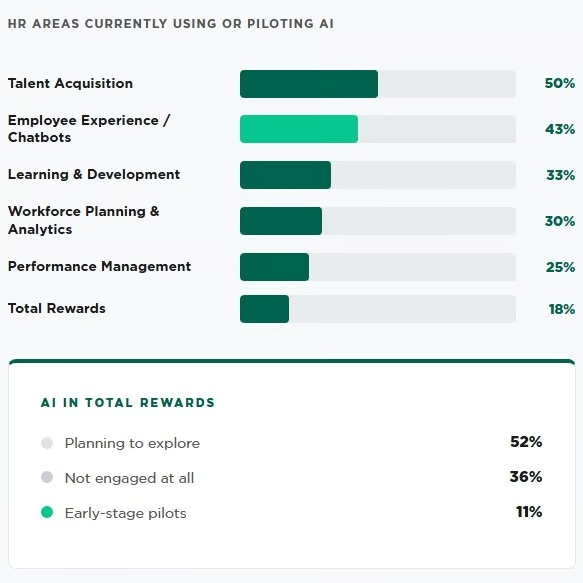
Employee resistance ranked low as a barrier at 15%, and the report links much of what managers call resistance to limited hands-on experience with the tools. HR functions are active users, with talent acquisition leading at 50%, followed by employee experience chatbots at 43%, and learning and development at 33%. Only 11% of organizations use AI in total rewards, even at an early stage, and 64% have no defined pay approach for AI and data roles.
Many of the decisions holding pilots back, including who gets reskilled, how AI roles are paid and which jobs get redesigned, already stem from HR leadership. "Today's CHROs aren't just shaping the talent agenda. They're helping to shape the entire strategic direction of the organization, influencing decisions that impact everything from corporate culture to the bottom line," said Vijay Gandhi, regional director for Korn Ferry Digital in EMEA.